


Key Points:
- School-based ABA therapy helps autistic students learn classroom routines, follow instructions, and manage transitions.
- BCBAs and teachers use visual aids, reinforcement, and data to track progress.
- Parents mirror strategies at home, while IEP teams adjust goals based on student performance.
Many families see their child struggling in class long before they ever sit in an autism evaluation room. Maybe the teacher keeps sending home notes about wandering, loud reactions to noise, or meltdowns during transitions. At the same time, families want their child to learn, make friends, and feel safe at school.
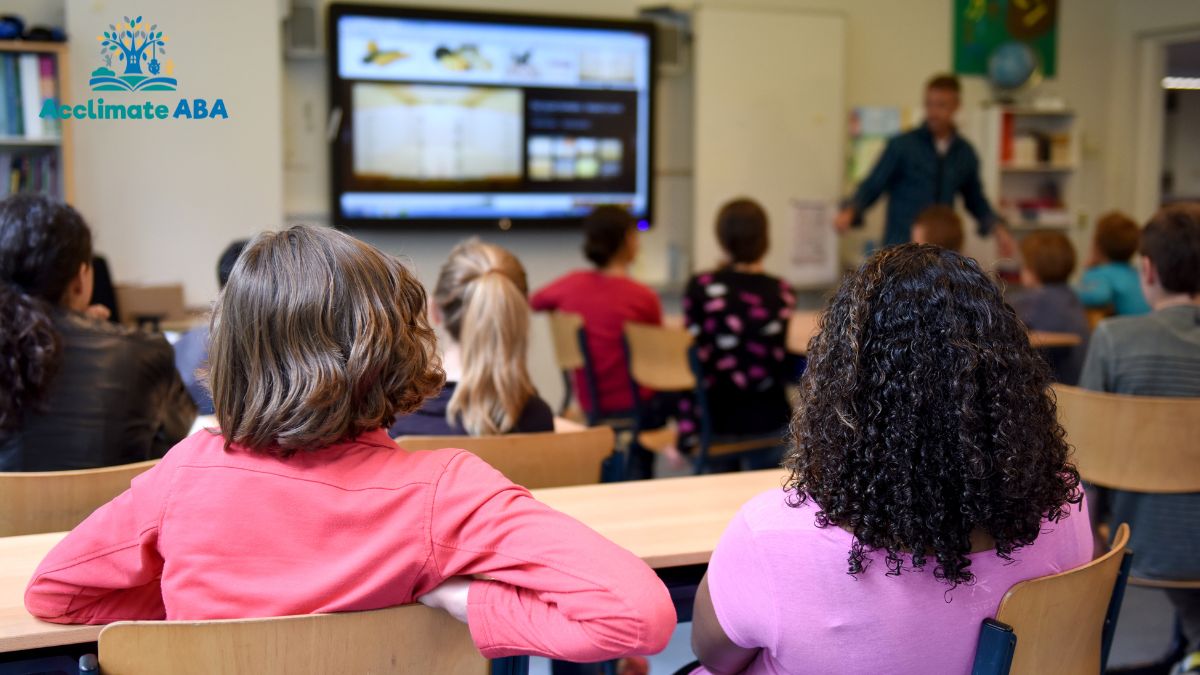
School-based ABA therapy offers a way to turn those daily classroom struggles into teachable skills instead of ongoing crises. Instead of talking about why ABA helps in theory, this guide walks through how school-based ABA works inside real classrooms, how BCBAs and teachers coordinate, and how parents can carry those gains into everyday life at home.
 What Does School-Based ABA Therapy Look Like in the Classroom?
 What Does School-Based ABA Therapy Look Like in the Classroom?
School-based ABA therapy starts with a clear picture of what actually happens during the day. Educators and BCBAs do not just label behavior as “good” or “bad.” They look at:
- What happens right before the behavior?
- What the student does.
- What happens right after?
Researchers describe applied behavior analysis as one of the behavioral approaches with the strongest evidence for supporting autistic learners, especially when it focuses on everyday skills and participation. That same framework can guide an ABA based classroom and autism classroom environment so support is woven into academic work, group time, and specials.
Common ABA-style classroom goals include:
- Staying seated during instruction. The student learns to remain in their chair for short, then longer chunks of time while a teacher speaks or peers work.
- Following group instructions. The student practices simple, clear directions like “Get your math folder,” “Line up at the door,” or “Hands in your lap.”
- Handling transitions. The student learns how to move from preferred to less preferred tasks, such as from recess to reading, with fewer disruptions.
- Raising a hand or using a signal. The student practices asking for breaks, help, or attention in ways that work in a busy room.
- Participating in peer activities. The student rehearses small-group activities, partner work, and simple cooperative games.
The goals are broken down into small, teachable steps in a school setting. For example, “staying seated” might begin with just 30 seconds of sitting, then one minute, then three minutes, paired with praise or other reinforcement when the student meets the target.
Classroom staff use tools that build on behavior management strategies for autism, like the following:
- Visual schedules and picture cues.
- First–then boards (“First worksheet, then break”).
- Token boards or point systems.
- Quiet reminders and prompts.
The goal is not to control the student. The goal is to make expectations predictable and give the student clear ways to succeed.
How Does School-Based ABA Therapy Classroom Support Set Goals for Students?
School-based ABA therapy classroom support always begins with a plan. Under the Individuals with Disabilities Education Act (IDEA), about 7.5 million students ages 3–21 receive special education services in U.S. public schools, roughly 15% of all students. Autism represents a growing portion of that group, so clear goal-setting is essential.
For a student with autism, the IEP team and BCBA look at:
- Academic access. Can the student attend to instruction long enough to learn?
- Safety and independence. Can the student move through the school building safely, follow routines, and ask for help?
- Social participation. Can the student join morning meeting, lunch, and recess without constant distress?
From there, they write measurable goals that fit the therapy, such as:
- “During whole-group reading, the student will remain in their seat for 10 minutes with no more than two prompts in 4 out of 5 days.”
- “During transitions, the student will move from one activity to the next within 3 minutes using a visual schedule in 4 out of 5 opportunities.”
- “During small-group work, the student will request a break using a card or device in 80% of observed opportunities.”
To reach those goals, the team defines specific ABA strategies:
- Prompting plan. Decide how adults will cue the student (gestures, pointing, modeling, or brief verbal prompts) and when to fade support.
- Reinforcement menu. Identify rewards that are actually meaningful to the student, such as small movement breaks, access to a preferred item, or positive feedback.
- Data collection system. Choose what to track, such as duration of on-task behavior, number of transitions completed, or prompts required, following a functional behavior assessment example that fits the student’s needs.
In an ABA based classroom, the BCBA often writes a behavior intervention plan (BIP) that sits alongside the IEP. The BIP explains triggers, prevention strategies, teaching steps, and responses to challenging behavior so all adults react in similar ways.
Over time, data drives changes. If the student meets a sitting goal easily, the team can raise expectations. If transitions remain hard, the team can adjust supports, such as adding preview cards or more transition warnings.
How Do BCBAs and Teachers Work Together Day to Day?
BCBAs do not replace teachers. Instead, they act as behavior and learning specialists who help make instruction more accessible for autistic students. Collaboration between educators and BCBAs has been linked with stronger student outcomes and better staff confidence in handling behavior plans.
When therapy happens in a school setting, collaboration often looks like:
- Regular classroom visits. The BCBA observes natural routines such as arrival, whole-group teaching, and lunch to see how plans play out.
- Brief debriefs. Teacher and BCBA quickly review what worked, what did not, and where students showed progress.
- Shared planning time. They review upcoming units, assemblies, and schedule changes so supports can be prepared ahead of time.
Effective teams usually put a few habits in place:
- Use shared language. Everyone describes behaviors and strategies in simple terms, such as “hands to self,” “waiting turn,” or “using break card,” so no one feels lost in technical talk.
- Align expectations. Teacher and BCBA agree on which behaviors to address first, so students receive consistent feedback.
- Protect teacher voice. Teachers share what fits their teaching style and classroom flow, and BCBAs adjust plans so they feel doable.
It has been proven that consistent communication helps teachers feel supported, especially when behavior plans are complex or span multiple settings.
What Classroom Routines Benefit Most From ABA Strategies?
Classroom life is built on routines. School-based ABA therapy works best when those routines become predictable practice opportunities instead of daily battles. Some of the most powerful ABA-supported routines include:
1. Morning Arrival
Morning sets the tone for the whole day. ABA strategies can support:
- Entering the building. Practice using the same entrance, greeting an adult, and hanging up belongings.
- Check-in routines. Use a simple feelings chart or visual check-in so the student can show how they feel at the start of the day.
- Transition to first activity. Use a visual schedule or timer to move from arrival to morning work.
2. Whole-Group Lessons
Group instruction can be hard for students who struggle with noise, movement, or long listening periods. Supports might include:
- Assigned seating with reduced distractions.
- Clear expectations posted in pictures (“Eyes on teacher,” “Hands in lap”).
- Short movement or sensory breaks built into the lesson.
3. Small-Group and Independent Work
During centers or desk work, ABA strategies can help students:
- Follow a clear work-before-break structure.
- Use visual checklists to complete tasks.
- Ask for help without leaving their seat.
4. Transitions and Specials
Transitions between rooms or teachers often trigger stress. School-based ABA therapy classroom support can include:
- Countdown warnings. “In two minutes, we clean up and line up.”
- Transition cards. Show where the student is going next (library, art, speech).
- Practice walks. Rehearse moving in the hallway when the building is quiet.
These routines repeat every single school day. That repetition makes them perfect practice grounds for new skills, especially when teachers and BCBAs track progress and adjust supports over time.
How Can Parents Reinforce ABA Classroom Gains at Home?
 How Can Parents Reinforce ABA Classroom Gains at Home?
Skills grow faster when parents and caregivers respond in similar ways at home. A large share of students receiving special education services now qualify under the autism category, so home–school teamwork has become even more important.
Parents do not need advanced training to help. Simple ideas about ABA parent training topics go a long way:
- Mirror classroom language. If teachers use phrases like “hands to self” or “quiet voice,” try the same wording at home. That consistency helps the child link expectations across settings.
- Use similar visuals. Ask for copies of the visual schedule, token board, or break card used at school and create a smaller version for home routines.
- Practice school routines at home. Set up “mock mornings” where your child practices packing a backpack, putting on shoes, and walking to the door after a timer.
- Celebrate the same skills. If the IEP focuses on waiting, praise your child when they wait for snacks, take turns in games, or have screen time.
Many families also join IEP meetings or check-ins with BCBAs to see classroom data. That shared information helps everyone spot patterns, such as behaviors that show up mainly before lunch, after long weekends, or during noisy assemblies.
Parents can also share what works at home. A simple strategy such as singing a preferred song during toothbrushing might inspire a similar approach during school hygiene lessons or life-skills classes.
How Do IEP Teams Coordinate School-Based ABA Support?
Behind school-based ABA therapy is an IEP team that meets regularly, reviews data, and updates plans. Federal law requires that each student with a disability have an individualized plan with measurable goals, services, and progress reports. l
For a student receiving ABA-based support, the IEP team usually includes:
- Parents or guardians
- General education teacher
- Special education teacher
- BCBA or behavior specialist
- Related service providers (speech, OT, PT, social work) when needed
- An administrator or district representative
During meetings, the team:
- Reviews data from the classroom. This may include graphs showing time on task, frequency of disruptive behavior, or independent work completed.
- Connects data to goals. They examine whether the student is on track to meet classroom-related goals, such as staying in class, joining group work, or managing transitions.
- Updates supports. If the student shows solid progress, the team may fade prompts or increase academic demands. If progress stalls, the team may add extra support, change reinforcement, or rethink goals.
School-based ABA therapy classroom support works best when these meetings are proactive. Consistent review helps the team catch small issues early, like new triggers or upcoming changes (field trips, schedule shifts, new teachers) that may require extra planning.
Frequently Asked Questions
 Frequently Asked Questions
Is school-based ABA only for students in special education classrooms?
School-based ABA is not limited to special education classrooms. Students can receive support in general education through push-in services from a BCBA or aide. ABA strategies apply across settings, including resource rooms and specials, depending on each student’s needs, goals, and independence level.
How often do BCBAs work directly with students during the school day?
BCBAs may work directly with students during assessments or specific sessions, but most of their school-day involvement focuses on training staff and shaping behavior plans. They guide routines, visuals, and reinforcement systems even when not present in classrooms. Direct student contact varies by district and student needs.
What should parents ask during meetings about school-based ABA?
Parents should ask about classroom goals, progress tracking, and home support strategies during school-based ABA meetings. Key questions include who implements the plan, how often updates are shared, and how data informs decisions. Clear answers help parents stay involved and advocate effectively.
Connect Classroom ABA Support With Home Progress
Understanding how school-based ABA therapy classroom support works gives families, teachers, and students a shared roadmap for daily life at school. Evidence-based ABA therapy services in Utah help many children move from frequent classroom disruptions toward active participation, stronger communication, and more successful transitions across the day.
At Acclimate ABA, we collaborate closely with teachers, BCBAs, and families so classroom strategies do not stop when the bell rings. Our team builds behavior plans around real routines, shares clear data, and coaches caregivers on how to mirror those supports at home.
If you are ready to see what this kind of coordinated support could look like for your child, reach out today to start a conversation about next steps.

